
-
Share this page
Protection of Wi-Fi sensing against eavesdropping
Problem statement
With the emerging IEEE 802.11bf standard, Wi‑Fi modems will integrate both communication and sensing functionalities to monitor the environment, similar to radars (Wi‑Fi sensing). These functions will be coordinated, sharing spectrum and hardware, though dedicated signals will still be used. Wi‑Fi sensing will enable new applications to enhance home autonomy and security, such as monitoring elderly individuals or detecting critical events like falls. It builds on Wi‑Fi-based passive radar, which opportunistically uses existing signals for sensing.
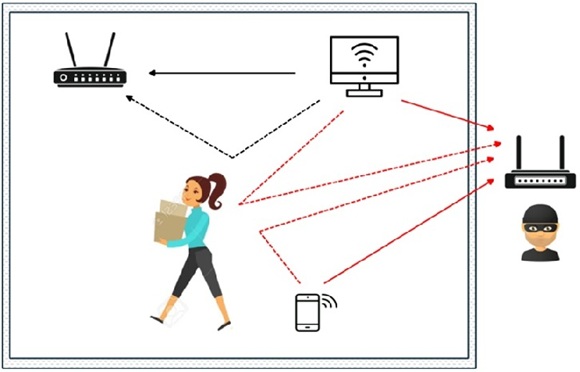
Despite its potential, Wi‑Fi sensing raises serious concerns about vulnerability to attacks. Eavesdroppers nearby could detect presence, track movement, or observe activities, even through walls. This risk is increased because sensing signals are optimized to detect human activity and may originate from multiple locations, while low-cost hardware is becoming widely accessible and adaptable.
In a realistic scenario, a sensing session involving one or multiple terminals (bi-static or multi-static setting) may be eavesdropped from outside the room. The first objective is to investigate the fundamental trade-offs between sensing the environment and protecting the environment against eavesdroppers. The second objective is to develop countermeasures to prevent sensing at eavesdroppers, considering both passive radar and coherent sensing strategies, which require concurrent defenses at legitimate devices. The third objective is to design methods to deceive the eavesdropper by creating a virtual scene that can still be canceled at legitimate receivers.
Low‑flying unmanned aerial vehicles (UAVs) represent a growing threat to critical infrastructures such as airbases, airports, and energy facilities. To mitigate these risks, wide‑area detection systems capable of providing early alerts are essential. Passive radar systems offer a compelling alternative to conventional active radars for UAV detection. Unlike active radars, which transmit and receive their own probing signals, passive radars exploit signals of opportunity already present in the electromagnetic environment, primarily originating from broadcast and cellular communication systems. This approach enables covert operation, reduced electromagnetic pollution, and lower deployment costs while leveraging existing infrastructure.
Contributions
-
Derivation of sensing performance bounds characterizing the advantage of the legitimate receiver with respect to the eavesdropper
-
Design of algorithms and architectures for a Wi‑Fi chain exposed to eavesdropping, supporting passive radar sensing on data or coherent sensing on pilots, along with associated protection mechanisms
-
Evaluation of these innovations relative to theoretical bounds, first through simulations using simplified channel models, and then through experimental validation with software defined radios (SDR)
Contact
► Pr. François Horlin- Dr. Nihad Elhag
- Ir. Julien Grolet
- Dr. Martin Willame
Collaborations
- Pr. Jérome Louveaux (UCLouvain)