
- Polytech
- Wireless Communications Group
- Projects
- People trajectory tracking with radars
-
Share this page
People trajectory tracking with radars
Problem statement
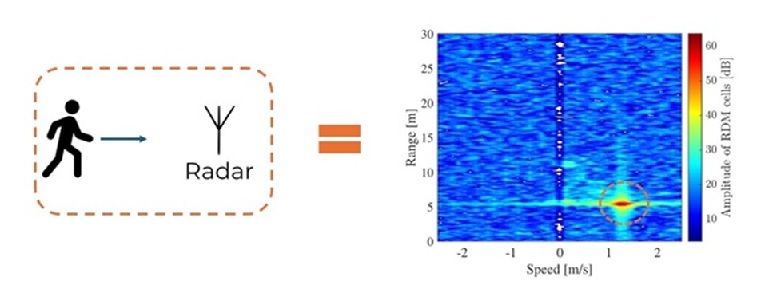
Crowd monitoring technologies are receiving increased attention as they may help city planners and local mass event organizers to better manage the daily commutes and prevent disasters in real-time. With a better understanding of the mobility patterns in our towns, the infrastructures may be better programmed to avoid congestion and adapted to the user expectations. In this context, sensing the pedestrian trajectories in public areas is a key ingredient to promote the soft mobility. While cameras are often the first considered technology, their performance is limited in low lightning conditions, and they are perceived as compromising user privacy. Radars are efficient to detect and track movement dynamics accurately under less stringent conditions than cameras while simultaneously preserving user privacy, thereby precluding ethical issues. They are of low-cost and easily deployed. The most widely used radar technology is the frequency-modulated continuous wave (FMCW) radar that enables the joint estimation of the target range and Doppler.
Critical situations call for a fine analysis of the movements of a higher number of individuals in a crowd. The objective of this project is therefore to conceive advanced tracking algorithms suited to infer the trajectories of a large number of individuals in a crowd with a millimiter-wave MIMO-FMCW radar. The algorithms are assessed based on simulations and with real-time data acquired with a setup recently installed on the U.L.B. campus.
Contributions
-
Radar processing, simulation environment and experimental setup
-
Kalman filter, data association and track management
-
Gaussian-mixture and particle PHD filters
Contact
► Pr. François Horlin- Ir. Mohcine Hamoumi
- Ir. Audrey Vermeulen
- Prof. François Quitin (ULB, BEAMS)
- Prof. Jérome Louveaux (UCLouvain)