
- Polytech
- Wireless Communications Group
- Projects
- Passive radars for UAV detection and tracking
-
Share this page
Passive radars for UAV detection and tracking
Problem statement
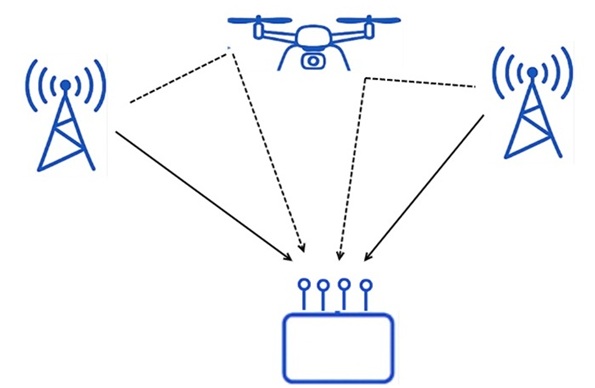
Low‑flying unmanned aerial vehicles (UAVs) represent a growing threat to critical infrastructures such as airbases, airports, and energy facilities. To mitigate these risks, wide‑area detection systems capable of providing early alerts are essential. Passive radar systems offer a compelling alternative to conventional active radars for UAV detection. Unlike active radars, which transmit and receive their own probing signals, passive radars exploit signals of opportunity already present in the electromagnetic environment, primarily originating from broadcast and cellular communication systems. This approach enables covert operation, reduced electromagnetic pollution, and lower deployment costs while leveraging existing infrastructure.
The project aims to design a digital television and cellular communication-based passive radar system capable of detecting, localizing and tracking UAVs. At the passive radar, the best transmitters will dynamically be selected and exploited to form multiple passive bistatic radar receiver-transmitter pairs. Local detections and tracks will then be fused to benefit from the complementary signal properties. The system will experimentally be validated using a software‑defined radio (SDR) receiver, enabling flexible signal acquisition and adaptation to different operational scenarios.

Contributions
- Signal acquisition and reference reconstruction
- Multi-band and multi-illuminator data fusion
- Exploitation of 5G NR mid-band signals for passive radar
- UAV detection, tracking and classification
- Prototyping with software defined radios (SDR)
Contact
► Pr. François Horlin- Ir. Ala Agrebi
- Ir. Amaury Arico
- Dr. Feten Slimeni
Collaborations
- Prof. Xavier Neyt (RMA)
- Prof. Jiang Liu (Waseda)